
Acid-Base Neutralization Calculator
Acid-Base Neutralization Calculator – Quickly Calculate Neutralization Reactions
Neutralization reactions are a core part of chemistry, especially in titrations, laboratory experiments, and industrial processes. An Acid-Base Neutralization Calculator helps you accurately determine how much acid is required to neutralize a base—or vice versa. This saves time, prevents calculation errors, and ensures perfect chemical balance.
Whether you’re a student, chemistry teacher, laboratory technician, or researcher, the calculator offers instant and precise results for all neutralization-related equations.
What Is an Acid-Base Neutralization Calculator?
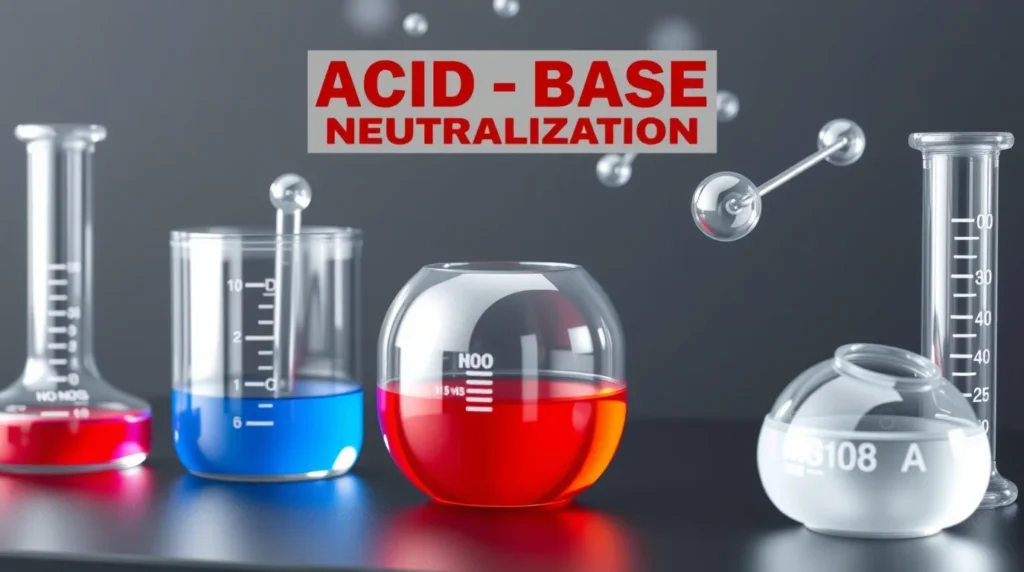
An Acid-Base Neutralization Calculator is an online tool that calculates the required volume or concentration of an acid or base to achieve complete neutralization.
It uses the balanced neutralization equation: n1V1=n2V2n_1 V_1 = n_2 V_2n1V1=n2V2
Where:
- n₁, n₂ = acid & base normality (or moles of H⁺/OH⁻)
- V₁, V₂ = volume of acid & base
This equation helps determine unknown values such as:
- Required volume of acid
- Required volume of base
- Concentration (M or N)
- Reaction equivalence point
Why Use an Acid-Base Neutralization Calculator?
✅ 1. Eliminates calculation mistakes
Manual titration formulas can get confusing. The calculator ensures accuracy.
✅ 2. Saves time in labs and classrooms
Instant results mean faster experiments and quicker assignments.
✅ 3. Perfect for titrations
Ideal for acid-base titration calculations in school, college, and research labs.
✅ 4. Supports multiple units
Molarity, normality, milliliters, liters, moles of H⁺/OH⁻, and equivalents.
How the Calculator Works
You simply input:
- Type of acid or base
- Concentration (M or N)
- Volume used
- Reaction ratio (from balanced equation)
The calculator automatically applies: C1V1=C2V2C_1 V_1 = C_2 V_2C1V1=C2V2
and provides:
- Required volume
- Neutralization point
- Step-by-step explanation
- Optional mole-based calculation
Common Uses of Acid-Base Neutralization Calculators
1. Acid-Base Titrations
Find the endpoint quickly and accurately.
2. Preparing laboratory solutions
Determine the exact acid or base concentration needed.
3. Industrial chemistry
Used in wastewater treatment and chemical manufacturing.
4. Classroom experiments
Simplifies calculations for students learning acid-base reactions.
Internal Resource: Chemistry Tools | Acid-Base Neutralization Calculator
Explore more concentration, dilution, and chemistry tools here:
👉 Chemistry & Math Calculators – desmoscalculatora.com
👉 ideal-gas-law-calculator
This link leads to free calculators for faster learning and experiments.
Example Neutralization Calculation
Problem:
How many mL of 0.5 M NaOH are required to neutralize 25 mL of 0.25 M HCl?
Solution: C1V1=C2V2C_1V_1 = C_2V_2C1V1=C2V2 0.25×25=0.5×V20.25 times 25 = 0.5 times V_20.25×25=0.5×V2 V2=12.5 mLV_2 = 12.5 , text{mL}V2=12.5mL
So, 12.5 mL of NaOH is required for complete neutralization.
External Reference for Concept Learning
Learn more about acid-base reactions from this trustworthy source:
👉 ChemLibreTexts – Acid-Base Reactions
A great resource for deeper understanding.
Conclusion
The Acid-Base Neutralization Calculator is an essential chemistry tool for students, researchers, and professionals. It ensures fast, accurate answers for titrations, lab experiments, and industrial calculations. If you want easier, faster, and error-free neutralization solutions, this calculator is the perfect digital assistant.
1 thought on “Acid-Base Neutralization Calculator”